Marks Ending : Codex Aleph (Sinaiticus)
Marks Ending Codex B (Vaticanus 1209)
EXTRA LINK

The study of errors in the NT manuscripts caused by similarities in nearby phrase endings.
...
Jan suggested to work with two dimensions in the classification: problems and causes. I immediately knew that was it! But how does that work, a classification with more than one dimension? I started to study the theory of classification, and I realized I had always been restricting myself to a certain form of classification, namely a taxonomy.
In a taxonomy, an object can occupy only one place in a hierarchical system: classifying a dog in a taxonomy of animals means positioning it at one of the branches of a tree, by means of characterizing it according to certain variables which are considered in sequence.
However, there is also a more complex form of classification: a typology. An example of a typology would be the characterization of a group of people according to their gender as well as to the colour of their hair. Each individual is not positioned within a hierarchical structure, as in a taxonomy, but characterised according to two variables that are considered in parallel, instead of in sequence.We needed a typology! The argumentation for each conjecture necessarily has two dimensions, the detection of a problem (in the transmitted text) and the suggestion of a cause of the supposed corruption (that is, a certain type of scribal error/change). ..."
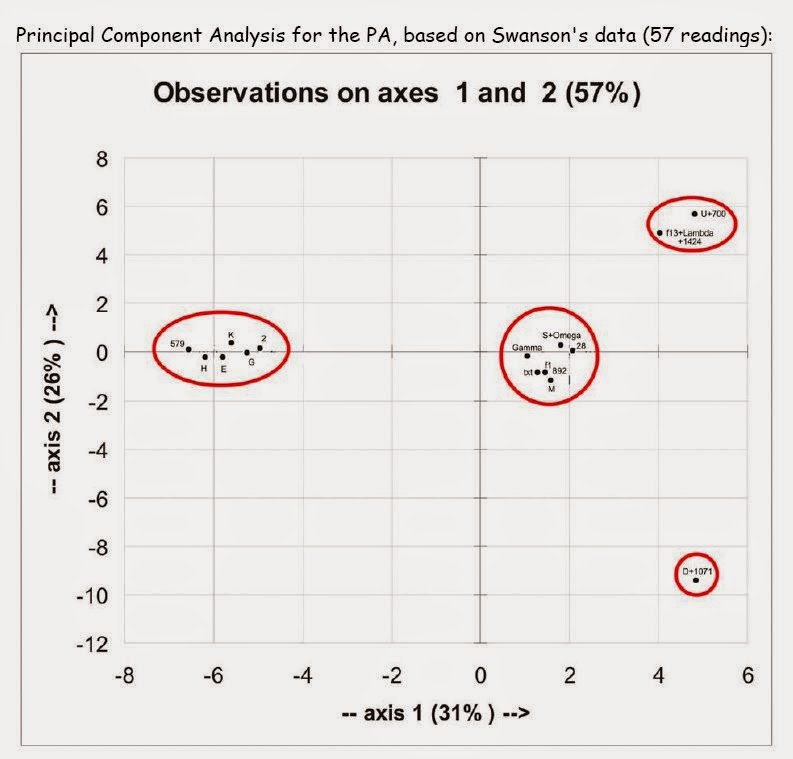 |
Example: Willker's Principal Components Analysis |


"But again and again some conjecture popped up that posed a problem and called for an adjustment of categories or definitions. Interestingly, most of the time such adjustments made the classification more straightforward, often making me wonder why that didn't occur to me earlier. ..."If early Textual Critics were given another chance at reconstructing the NT text, would they be able to adapt and embrace the more modern and multi-dimensional view of today, and reassess the crude and (in hindsight) misleading 'guidelines' of Textual Criticism of the 19th century?

"Amongst the many mistakes in the manuscript particular attention - so far as this edition of Enoch is concerned, - should be drawn to the existence of numerous omissions, many through homoioteleuton..." - The Ethiopic Book of Enoch, Michael Knibb, p. 17,(1978, Oxford Press) |
 |
| Click to enlarge: backbutton to return |
Tommy's excellent presentation on the text of Mark 1.1 is now available in audio via the CSCO website (where it is also described as argued persuasively):In his analysis, Tommy Wasserman notes that there are either 6 genitive endings of words in a row, or else 4 Nomina Sacra, creating an easy situation for error. In his opinion, the argument that omissions are unlikely in the very beginning of a book is outweighed by both the textual evidence and the intrinsic evidence regarding Mark's style and purpose.
Tommy Wasserman, ‘The “Son of God” was in the Beginning,’ lecture (44min)
Wasserman, Question and Answer, (28min)

" The further blanket claim that I “ascribe error and scribal slips to all the errors of Aleph & B” is simply incorrect. While I do maintain (on the basis of a careful examination of scribal habits) that scribal error is a primary cause of textual variation, I also clearly presume deliberate alteration and recensional activity to have occurred among the Alexandrian manuscripts (as per my 1993 article, “The Recensional Nature of the Alexandrian Texttype”). The leading principle in this regard is to presume scribal error as an initial factor so long as transcriptional probabilities suggest such, then to presume intentional change at whatever points transcriptional probabilities seem to be transcended for what appear to be stylistic or content-based “improvement” concepts in the eyes of particular scribes.I trust this will clarify the matter."

"To illustrate these [accidental errors], one or two instances under each head are selected from Mr. Hammond's recent convenient little manual (Outlines of Textual Criticism applied to the New Testament. By C. E. Hammond, M.A. Oxford : Clarendon Press. 1872. From this work much of the present paper has been abridged.)
Under errors of sight belong omissions from what is technically called Homoioteleuton. Thus, in Codex C, the words τουτο δε εστιν το θελημα του πεμψαντος με are omitted in John 6:39, because the last three words had occurred immediately before, and the eye of the scribe passed on from their first to their second occurrence. This happens especially when the same words occur at the end of consecutive lines.
To the same head belong the many instances, more generally in the uncial MSS., arising from the confusion of similar letters such as Α, Λ, Δ ; or Ε ς, Θ Ο. From this arose the well-known and well-disputed reading in 1 Tim. 3:16. Similar letters or syllables are sometimes omitted and sometimes inserted; thus in Matt. 26:39 for ΠΡΟΣΕΛΘΩΝ Cod. B has ΠΡΟΕΛΘΩΝ, and in Luke 9:49 Cod. H has εκβαλλοντα τα δαιμονια for εκβαλλοντα διαμονια . Letters, too, are sometimes transposed, so that in Acts 13:23 for ΣΠΑΙΝ, Codd. H and L read ΣΠΙΑΝ {σωτηρα Ιησου} . The number of errors from this source is very large, as the margin of any critical edition will readily show."

"[to] Steven Avery: when I opened my translation of the gospel of John, I see this:'Codex Barococciani 206 θ, A.D. 692'I apparently already corrected [this] sometime in the past, probably in 2008. You have an old copy of my work.
Here, get the current one: Greek-English John w Apparatus http://bibletranslation.ws/trans/johnwgrk.pdf The current one [Greek text of John with apparatus], unlike the copy you have, also has adopted 3 or 4 suggestions from Nazaroo as to instances of homoioteleuton in the NA27 text. So, your copy is very much out of date.
David Robert Palmer
http://bibletranslation.ws/palmer-translation/
Message #4544 Sept 23, 2011, TC-Alt List


"PREFACE
...Whenever the readings of two MSS ...are compared, ...one of them does not contain passages which occur in the other. In all such cases there are two possible explanations, viz., that the words are spurious, ...inserted by an interpolater..., or that they are genuine, and have been accidentally omitted by the other [copy]. The hypothesis of accident [omission] is highly probable, when there is a reason which will account for the omission.One such reason is universally recognized, viz., homoeoteleuton. [h.t.] When a similar ending, or word occurs twice in the same sentence, a copyist [could have] easily passed from the first passage to the second, omitting the intermediate words. This saut du meme au meme ["jump from meme to meme"] is the most prolific cause of omissions.There is another reason which is not infrequently suggested by editors, viz., that the scribe has accidentally omitted a line, or several lines, of his model. When we have two MSS, one which is known to be a transcript of the other, we find actual instances of such omissions. In the vast majority of cases however, we have only the copy, not the [exemplar]. Since all scribes [copyists] are subject to the same errors, it is reasonable to suppose that omissions in a particular MS may represent a line or number of lines [skipped] in an ancestor... the problem is to find an objective criterion..to detect line-omissions....[groups of] short passages...doubted on the ground of their omission by a MS or family, frequently contain the same, or nearly the same number of letters. Longer passages in the same way [are] multiples of this unit. The natural inference is that the unit [and longer omissions] correspond to [physical] lines in [the layout of] an ancestor.Ancient Uncial MSS are written with few abbreviations and no space between words [with] the number of letters per line ...a more or less constant [average] quantity.It was also easy for a copyist to omit other divisions in his [exemplar], viz., a colum, page, or folio [folded sheet]. Since it is usual for MSS to have the same # of lines per page, it follows that the contents of columns, pages, & folios are similar [in size]....The chief result of my investigation has been to show the falsity of the principle brevior lectio potior ("prefer the shorter reading"). This was laid down by Griesbach as a canon of criticism in the words:"Brevior lectio, nisi testium vetustorum et gravium auctoritate penitus destituatur, praeferenda est verbosiori. Librari enim multo proniores ad addendum fuerunt quam ad omittendum.""The Shorter reading, unless the authority of the witnesses completely lacks a weight and age, is preferable to the verbose. Copyists were much more prone to add than to omit."
[But] this statement has no foundation in facts. I may also observe that it is not so easy to invent as it is to omit.
...
I had been brought up to look on the Revised Text as final, to smile at persons who maintained the authenticity of St. Mark 16:9-20 or St. John 7:53-8:11, and to suppose that the 'vagaries' of the 'Western text' were due to wholesale interpolation. The object which I had in view was merely to study the mutual relations of the oldest Greek Uncials, notably, the Vaticanus (B), Sinaiticus (Aleph), and Alexandrinus (A). I was however, soon dislodged from this arrogant attitude, and irresistibly driven to very different conclusions.
...
Nowhere is the falsity of the maxim 'Prefer the shorter reading' more evident than in the New Testament. The process [over time in copying] has been one of contraction, not expansion. The primitive text is the longest, not the shortest."

'The study of scribal habits reflects ongoing interest in individual documents. Recent publications focus on P45, (50) P66, (51) Codex Sinaiticus, (52) the major manuscripts of Revelation, (53) and a detailed survey of six important New Testament papyri. (54) One resulting observation is that material is more commonly omitted than added in extant papyri, reinforcing the fact that the text-critical canon of lectio breuior potior must not be applied indiscriminately. (55)
Although the identification of scribal practice has traditionally proceeded on the basis of 'singular readings' peculiar to a manuscript, the number of genuinely unique readings (not taking into account nonsense forms) is being diminished as more manuscripts are transcribed in full. The current definition adopted for a singular reading as one "which has no Greek support in the critical apparatus of Tischendorf's 8th edition" (56) will have to be reviewed with the publication of the ECM.
A further methodological issue is that, given the gaps in our knowledge of the tradition, the presence of a particular form in the first-hand text of a given manuscript cannot necessarily be ascribed to the copyist's choosing but may have been inherited from the exemplar: the characteristics isolated by the study of singular and sub-singular readings apply not so much to the scribe as to the form of text found in the manuscript. Only the study of corrections and other annotations provides firm evidence for the intervention of individuals. This also poses problems for accounts of theologically-motivated alterations to the biblical text, made popular by Ehrman's The Orthodox Corruption of Scripture.(57)
While certain variants may be interpreted theologically, only if a consistent pattern can be identified within a single manuscript are there grounds for identifying a particular bias – which was most probably not introduced by the copyist but by an editor during the preparation of the text for copying. The claim that "some scribes" modified the text by independently introducing identical variants is implausible (unless the separate emergence of the readings can be demonstrated) and fails to take account of the nature of the copying process.' (58)
50. J.K. Elliott, "Singular Readings in the Gospel Text of P45," in The Earliest Gospels ed. Charles Horton (JSNTSupp 258, London: T&T Clark, 2004), 122–31.
51. Peter M. Head, "Scribal Behaviour and Theological Tendencies in Singular Readings in P. Bodmer II (P66)," in Textual Variation ed. Houghton and Parker, 55–74.
52. Dirk Jongkind, Scribal Habits of Codex Sinaiticus (TS 3.5, Piscataway NJ: Gorgias, 2007).
53. Juan Hernández Jr, Scribal Habits and Theological Influences in the Apocalypse. The Singular Readings of Sinaiticus, Alexandrinus, and Ephraemi (WUNT 2.218. Tübingen: Mohr Siebeck, 2006).
54. James R. Royse, Scribal Habits in Early Greek New Testament Papyri (NTTSD 36. Leiden: Brill, 2008).
55. See also Peter M. Head, "The Habits of New Testament Copyists. Singular Readings in the Early Fragmentary Papyri of John," Bib 85.3 (2004): 399–408.
56. E.C. Colwell, "Scribal Habits in Early Papyri: A Study in the Corruption of the Text," in The Bible in Modern Scholarship ed. J. Philip Hyatt (Nashville TN: Abingdon, 1965), 372–3.
57. Bart D. Ehrman, The Orthodox Corruption of Scripture. The Effect of Early Christological Controversies on the Text of the New Testament (New York & Oxford: OUP, 1993); see also Wayne C. Kannaday, Apologetic Discourse and the Scribal Tradition. (SBLTCS 5. Atlanta GA: SBL, 2004).
58. On this, see especially Ulrich Schmid, "Scribes and Variants – Sociology and Typology" in Textual Variation ed. Houghton and Parker, 1–23, and other papers in the same volume; Michael W. Holmes, Text of P46: Evidence of the Earliest 'Commentary' on Romans?" in New Testament Manuscripts ed. Kraus and Nicklas, 189–206.Certainly, Hernández (2006), Jongkind (2007), and Royse (2008) have gathered and analyzed a vast amount of detailed data from the papyri, and these three works stand out especially high above their contemporaries, and must be considered highly recommended reading. It is hard to see however, what value Bart Ehrman's work can be granted, given his crippling atheistic bias in regard to the Bible text, - or what little there is remaining that can be milked out of Colwell's acknowledged pioneering (pre 1965), but now hopelessly out of date study.
 |
| click to enlarge |


